Medieval Guntur
From the later Eastern Chalukyas to the fall of Golconda, this tract was never only a town. It was Velanadu and Palnadu, the Kondavidu hills, a port on the old Guntur coast, and a chain of forts. Chiefs collected tax, married into one another’s families, and dated their stones in the years of a distant emperor. Then the emperors themselves came closer.
The name of the town was already old when these centuries opened. Kumturu had been written in 669. In the tenth century the Ederu plates of Amma I called it Gonturu / Gomturu. That form runs on in regional inscriptions into the fourteenth century. The district page also mentions two later inscriptions of 1147 and 1158.
Velanadu and the local houses
From about 1075 to about 1200 the Chalukya–Chola kings were the imperial names over coastal Andhra. The court was far away. On the ground, four houses were the lords of this plain.
The Velanati Chodas — Velanadu Durjayas — held capital at Chandavolu (Chandole) from about 1100 until the Kakatiyas absorbed the kingdom around 1257. They belonged to the Durjaya family and used “Choda” as a mark of Chola allegiance. Their inscriptions stand at Draksharamam, Chandavolu, Tripurantakam, Dharanikota, and Chebrolu.
Gonka II (inscriptions about 1128–1161/62; independent rule from about 1137) is the greatest of the line in the stones. His records appear at Guntur, Nadendla, Draksharamam, Bapatla, Konidena, Kalahasti, and Nidubrolu. He still dates them in the years of Kulottunga II and Rajaraja II. In 1147 his officers and those of Kamaraja of the Palnad Haihayas made a joint gift at Peddakodamagandla. Bapatla appears in his records as Prempalli, in Kammanandu.
Around 1157–1158 Kakatiya Prola II died in a war on Velanadu. Several houses claimed the deed. A crown-prince Choda II later bears the title Kakatiprolanirdahana; so does Kota-chodaya-raja in a 1158 Draksharama inscription of queen Surama-mahadevi. This site says only what the titles say: several twelfth-century houses claimed the death of Prola II.
The Kotas of Dharanikota (about 1100–1270) called themselves lords of Dhanyavati and devotees of Amaresvara at Amaravati. Main capital Dharanikota; other seats at Yanamadala, Tadikonda, Tripurantakam. Kota Keta II’s inscriptions begin in 1182 at Amaravati and run to 1231. Kakatiya Ganapatideva gave a daughter, Ganapamba, to Betaraju of the Yanamadala branch; after his death she ruled as Mahamandalesvara, owing allegiance to her sister Rudramadevi.
The Kondapadumatis of Nadendla (about 1100–1282) held the country west of the Kondavidu hills. Chebrolu inscriptions call them chaturtha-kula. Their own later prasasti says an ancestor received seventy-three villages from Kubja Vishnuvardhana in the seventh century — a charter-myth of origin, not a twelfth-century fact. They were allies by marriage of the Velanati Chodas, lost ground to the Kotas, and ended as Kakatiya subordinates.
Other attested chiefs include the Chagis, and, in the thirteenth century, Yadava-Chodas at Kondavidu. Four Telugu inscriptions found in 2023 at the fort include one of Mahamandalesvara Malla Yadava Chola. The hill was already a built, inscribed place before it became a Reddi capital. A local tradition that the village was fortified in 1115 by Gopanna, a commander of Buddhavarma, is widely repeated. It is tradition.
Solid countryside dates sit beside these houses. At Amrutaluru, in the Tenali mandal, a pillar of 1132 records Gonkaya Boya, in charge of 480 villages, as a vassal of Kulottunga Rajendra Choda, gifting fifty sheep for a perpetual lamp. At Appikatla, in 1172, Velanati Kulottunga Rajendra Choda granted land for a temple. Chebrolu’s cluster of four temples — Chaturmukha Brahmeswara, Bhimeswara, Adikesava, Nageswara — is placed between the ninth and twelfth centuries. Adikesava is described as Chola in style.
Palnadu, Guntur’s own epic
This is the one medieval event every Guntur household already knows.
A Haihaya family ruled the Palnad tract in the twelfth century from Gurazala, also called Madhavipattana. They sit in the stones. The earliest dated record used here is the 1103 Satrasala inscription of Beta I. Further inscriptions stand at Bhungubanda (1118) and Gurazala (1129, 1137). In 1147 Velanati and Palnad officers made a joint gift. The Haihayas made temple donations — and then they disappear from the inscriptional record.
The oral and literary cycle — Palnati Virula Katha, Palnati Vira Charitra, sometimes Palnati Vira Bharatam — tells a Mahabharata-shaped civil war: step-brothers Nalagamaraju of Gurazala, advised by Nayakuralu Nagamma, and Malidevaraju of Macherla, advised by Brahma Naidu; a cock-fight; exile; war at Karempudi on the Naguleru. Neighbouring houses take sides. A generation of warriors dies. Brahma Naidu’s son Balachandra is the local Abhimanyu.
Honour that katha. It is Guntur’s own epic. It is sung every year at the Chenna Kesava temple in Macherla.
Then say, plainly, what kind of evidence it is. The written Palnativiracaritra of Srinatha and that of Virabhadrakavi were composed about two and seven centuries after the battle of Karampodi, and they narrate the war as later poets knew it. The conventional dates are 1178–1182; the district page remembers 1180 as “Andhra Kurukshetra.” There is no dated battle inscription. The names of the katha are the names of the katha. Who won is unresolved in scholarship. No dialogue from the poem is spoken here as twelfth-century speech.
The Haihayas of Gurazala are real. The great battle as we tell it is a later poem built on a real, poorly documented civil war.
The Kakatiyas
The Kakatiyas began as Western Chalukya samantas in Telangana. After Prola II’s death, his son Rudradeva proclaimed sovereignty in 1163. Coastal Andhra came into their orbit in stages, not in a single conquest. Rudradeva’s foothold in this tract was early and limited.
Ganapatideva (about 1199–1262) is the reign in which the Kakatiya state becomes visible all over the old Guntur district.
At Chebrolu, Ganapati appointed Jayapa of the Ayya family governor of newly conquered Velanadu. Jayapa’s 1213 inscription says that on return from a southern campaign the king conferred the southern region and the city of Shanmukha — Chebrolu — on him. A 21 April 1235 record says he built the Chodesvara temple in his father Pinna Choda’s name, granted Modukuru village, and built two-storeyed quarters for temple dancers.
At Motupalli, then in Bapatla taluk of old Guntur district and now on the Prakasam coast, Ganapatideva set up the Abhaya-sasana in Saka 1166, 1244–45. On a pillar before the Virabhadra temple he guarantees sea-going merchants security of cargo and lists fixed duties, ending the practice of seizing wrecks. Sanskrit and Telugu. Marco Polo later knew the port as Mutfili and wrote of a kingdom “ruled by a queen” — usually read as Rudrama — and of fine cottons and diamonds.
At Malkapuram, in Guntur taluk, a granite Nandi-pillar of Saka 1183, 1261 CE, records that Ganapatideva granted Mandaram, and his daughter Rudramadevi granted Velagapudi, to his diksha-guru Visvesvarasivacarya of the Golaki-matha. The acarya founded Visvesvara-Golaki: a Siva temple, a Sanskrit college, a Saiva matha, a choultry feeding people without distinction of caste or creed, a general hospital and a maternity hospital.
Kakatiya records also stand at Durgi in Palnad — Ganapatideva in 1215, Rudrama in 1269.
Under Prataparudra II, inscriptions thicken in Palnad and Sattenapalle: Voppicherla 1299; Karempudi 1303 and 1316; Chintapalle 1304; Macherla 1313 and 1314, including a “temple of heroes” on the Chandravanka and land set aside as a hero’s prebend; Durgi and Jonnalagadda 1319; Motupalli 1322. Karempudi and Macherla receive Kakatiya grants a century after the war. That is the inscriptional afterlife of Palnadu’s dead, not a confirmation of the katha’s plot.
Warangal fell to the Delhi Sultanate in 1323. Kakatiya imperial history in this tract ends there.
The Reddis and Kondavidu
After 1323 the Tughluq hold on coastal Andhra was brief. Among those who recovered the country was Prolaya Vema Reddi, founder of the Reddi kingdom.
The standard scholarly range is 1325–1448. The first capital was Addanki. Later the fortified hill of Kondavidu (Kondaveedu), west of Guntur, became the seat. Who moved the capital, and in which year, is told differently in the handbooks. Some give the move to Prolaya Vema; others to Anavota Reddi. This site says only: mid-fourteenth century, Addanki to Kondavidu, and both kings appear in the tradition.
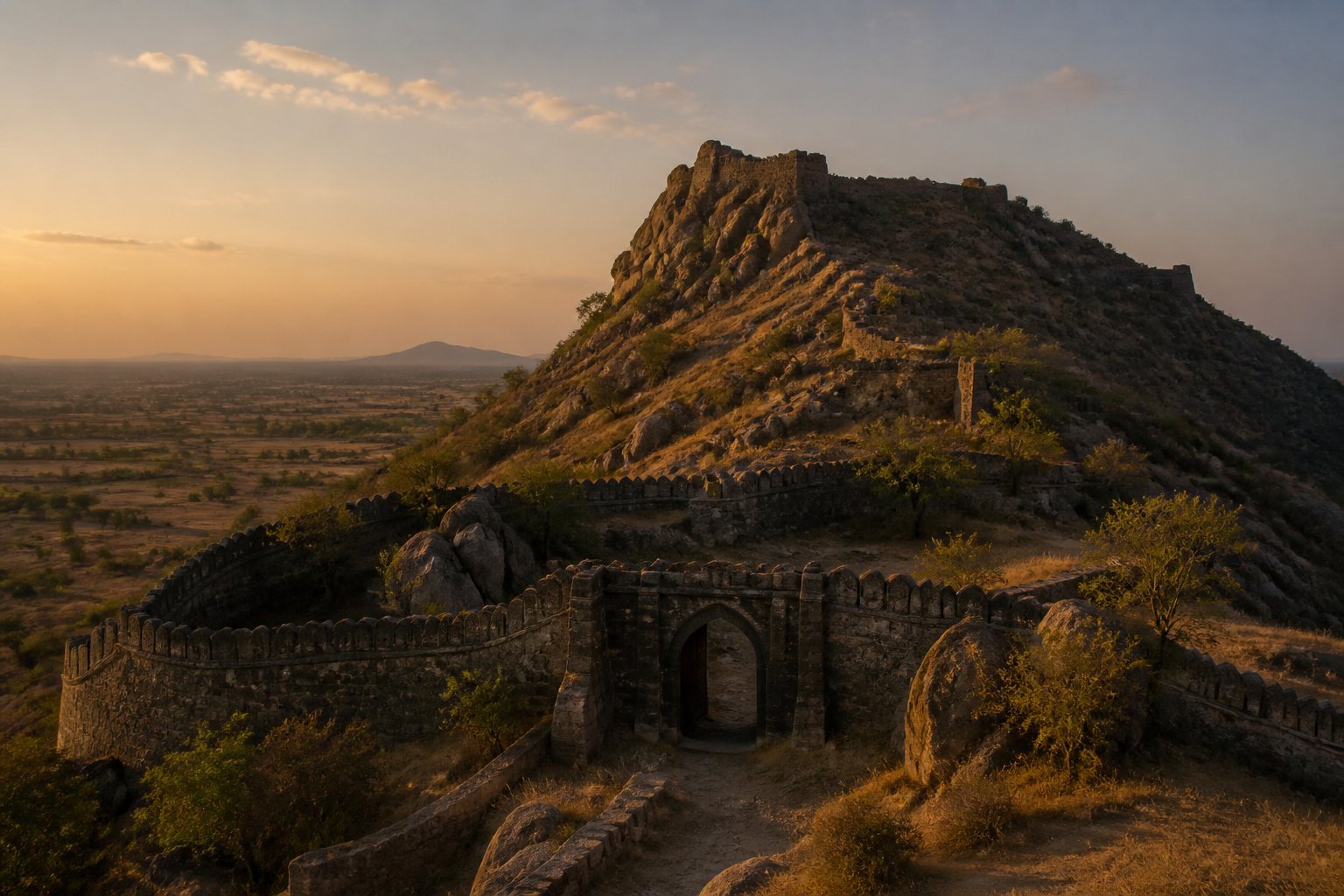
Kondavidu is a complex of hill forts on a ridge. The Reddis were famous as fort-builders: Kondavidu, Kondapalli, Bellamkonda, Vinukonda, Nagarjunakonda. Gordon Mackenzie, writing in 1883, said Pulayya Vema Reddi “established himself in the hill fort of Kondavidu, which had doubtless been a stronghold for some centuries previous.”
A fourteenth-century Telugu inscription, found in 2026 on a broken pillar of a ruined Siva temple on Rudrapada peak, records a grant of vrittis for worship in a Siva temple at Kondaveedu. The invocation is Sri Kailasa Sivaya Namah. The ruler’s name is not on the surviving fragment; scholars have guessed Anavema or Pedakomati Vema. Pedakomati Vema, named in other Kondavidu records brought to light in 2024, was the patron of the poet Srinatha — the same literary world that later wrote Palnadu’s war.
Bellamkonda, in colonial description, is “said to have been constructed by the Reddi kings of Kondavid.” That is tradition plus a later chronicle, not a foundation inscription.
Gajapatis, and Krishnadevaraya on 23 June 1515
The Reddi kingdom did not fall to a single heir. From the mid-fifteenth century Kondavidu was a prize among Gajapatis of Odisha, Bahmanis, and Vijayanagara.
A 1454 record at Chintapallipadu names Ganadeva alias Rautaraya, devotee of Jagannatha, as governor of Kondavidu; Addanki, Vinukonda, and Kondavidu are mentioned. In 1455 he granted Chavali to Brahmins. Later memory — the Kondavidu Kaifiyat, colonial pages, encyclopedia summaries — gives a sequence of Gajapati, Bahmani, and Gajapati again before 1515. Those years are a memory of ping-pong, not a single archive.
Then comes one of the best-dated events in the district’s medieval history.
Inscriptions at Mangalagiri, Kaza, and Kondavidu say the fortress surrendered on Saturday, the Harivasara of the bright half of Ashadha, Saka 1437 expired — Saturday, 23 June 1515. The Portuguese chronicle of Nuniz describes a two-month siege, the capture of Virabhadra, son of Prataparudra Gajapati, and Oriya nobles, and a governor left behind. That governor, in the Kondavidu inscription, is Nadendla Gopamantri, nephew of the minister Saluva Timma. After the fall, the Raya visited Amaresvara at Dharanikota and performed tulapurusha on the Krishna.
Forts that inscriptions and later narrative say fell in the same eastern campaign include Udayagiri, Kandukur, Addanki, Vinukonda, Bellamkonda, Nagarjunakonda, Tangeda, Ketavaram, then Kondavidu, then the coast to the Krishna and beyond.
A stone pillar at the foot of the Mangalagiri steps, 1520, records the capture of Kondavidu by Timmarasu in 1515 from the Gajapatis. Another stone near Garudalvar records grants in the reign of Sadasiva Raya, 1538. Nadendla Gopa was still governor in 1520; a temple of Rama at Kondaviti received the customs of the Kondaviti country. The great raja-gopuram at the foot of the Mangalagiri hill is not medieval: Vasireddy Venkatadri Nayudu built it in 1807–1809.
Golconda, to 1687
From the 1530s the new sultanate of Golconda pressed the Krishna–Guntur forts. The usual colonial list names three attempts on Kondavidu: 1531, 1536/37, and 1579.
In April 1579, in the reign of Ibrahim Qutb Shah (r. 1550–1580), Kondavidu fell after bombardment. It was renamed Murtazanagar (also Murtuzanagar, Mrittijanagara). Under Hindu kingdoms the country had been Kondavidu Sima; under Golconda and Hyderabad it was the Murtazanagar Circar. Mackenzie wrote that Hindu rule in the Kistna country ends when Kondavidu falls to the Muhammadans in 1579. Bellamkonda, in the Firishta / gazetteer tradition, is given as 1578.
South Indian Inscriptions volume 10 preserves the everyday Qutb Shahi district: a copy at Malkapuram, 1530, of a Kondapalli grant for a choultry; a land measurement of nineteen villages at Malkapuram, 1577, under the orders of Ibrahim Shah; rebellion suppressed at Aminabad, 1592, by general Malka Amin for Muhammad Quli; temple and mango-tope grants at Jagarlamudi in Mrittijanagara-sima; Eklaskhan, trusted general of Muhammad Padshah son of Ibrahim, founding Eklaskhanapuram about 1600 as governor of the Kondavidu and Addanki districts; a lamp grant at the Chenna Kesava temple, Macherla, 1619; tanks, wells, and boundary settlements on into the 1680s.
Aurangzeb’s capture of Golconda in 1687 ended the sultanate. Guntur, as part of that state, passed into the Mughal Hyderabad Subah. The next chapter — Nizam, French, Company — is told on To Independence.