To Independence
This page runs from the late seventeenth century to the morning of 15 August 1947. Nothing after that morning is treated as part of this story, except one line: Andhra State, formed in 1953, lies beyond this site.
The place names follow the sources of their own time: Circar, Kistna, Masulipatam, Bezwada, Palnad, Guntoor.
Circars
Long before a collector sat at Guntur, the same stretch of Krishna plain and Palnad hills had older administrative names. Under successive Hindu kingdoms the country was Kondavidu Sima. Under the sultans of Golconda and then Hyderabad it was the Murtazanagar Circar — one of the five Northern Circars. The five were Chicacole (Srikakulam), Rajahmundry, Ellore (Eluru), Mustaphanagar (Kondapalli), and Murtuzanagar (Guntur).
When Golconda fell in 1687, the Circars were added, with Hyderabad, to Aurangzeb’s empire. In 1724 Asaf Jah, the Mughal viceroy in the south, became in practice independent. Guntur’s late-Mughal story runs through Golconda, Aurangzeb, and the Nizam — not through the Nawabs of the Carnatic.
The French headquarters, 1752–1759
European factories on this coast were older than French rule in Guntur. The English had landed at Nizampatam and Masulipatam in 1611. The French useful local base was not Guntur town but the Godavari–Krishna factory world. In 1723 they opened a trading post at Yanam, from Masulipatam.
Salabat Jang, who owed his elevation as Nizam to the French East India Company, granted the district of Kondavid (Guntur) to the French in 1752, and the other Circars soon afterwards. The French set up district headquarters at the ancient village of Guntur, 1752–1759. That is the strongest dated statement that Guntur town became a European administrative seat in those years — not that the village itself was invented in the 1750s.
The 1911 Encyclopaedia Britannica wrote, more cautiously, that the town “appears to have been founded in the 18th century by the French.” Keep the hedge. The village is older. The French made it a headquarters.
In 1759, by the British conquest of Masulipatam, the maritime provinces from the Gundlakamma to the Chilka lake passed from the French to the British. The British then left those provinces under the Nizam, except the town and fortress of Masulipatam, which the Company kept.
The Company, and why Guntur came last
Guntur did not fall to the Company in one afternoon. The other four Circars went first. Guntur was held back as a brother’s jagir.
In 1765 Robert Clive obtained from the Mughal emperor Shah Alam II a grant of the five Circars. On 12 November 1766 a treaty of alliance with Nizam Ali followed. On 1 March 1768, by the Treaty of Masulipatnam, the Nizam resigned the Circars to the Company. Under both treaties Guntur, the personal estate of the Nizam’s brother Basalat Jang, was excepted during his lifetime.
Basalat Jang died in 1782. In 1788 Guntur came under British administration. (A 1940 treaty essay says 1789. This site follows 1788, the standard dated claim.) From that year a Company collectorate existed on this soil. In 1823 the Nizam’s remaining claims over the Northern Circars were bought outright.
The first years were hard. Frykenberg, quoting the Elliot Report, records that 1790–1800 was disastrous. A tidal wave in July 1791 wrecked coastal and river villages; standing water ruined grain stored in pits. The famine of 1791–92 was so severe that an estimated sixth of the poorer labouring people died. The next year was drought.
District: 1788, 1859, 1904, 1909
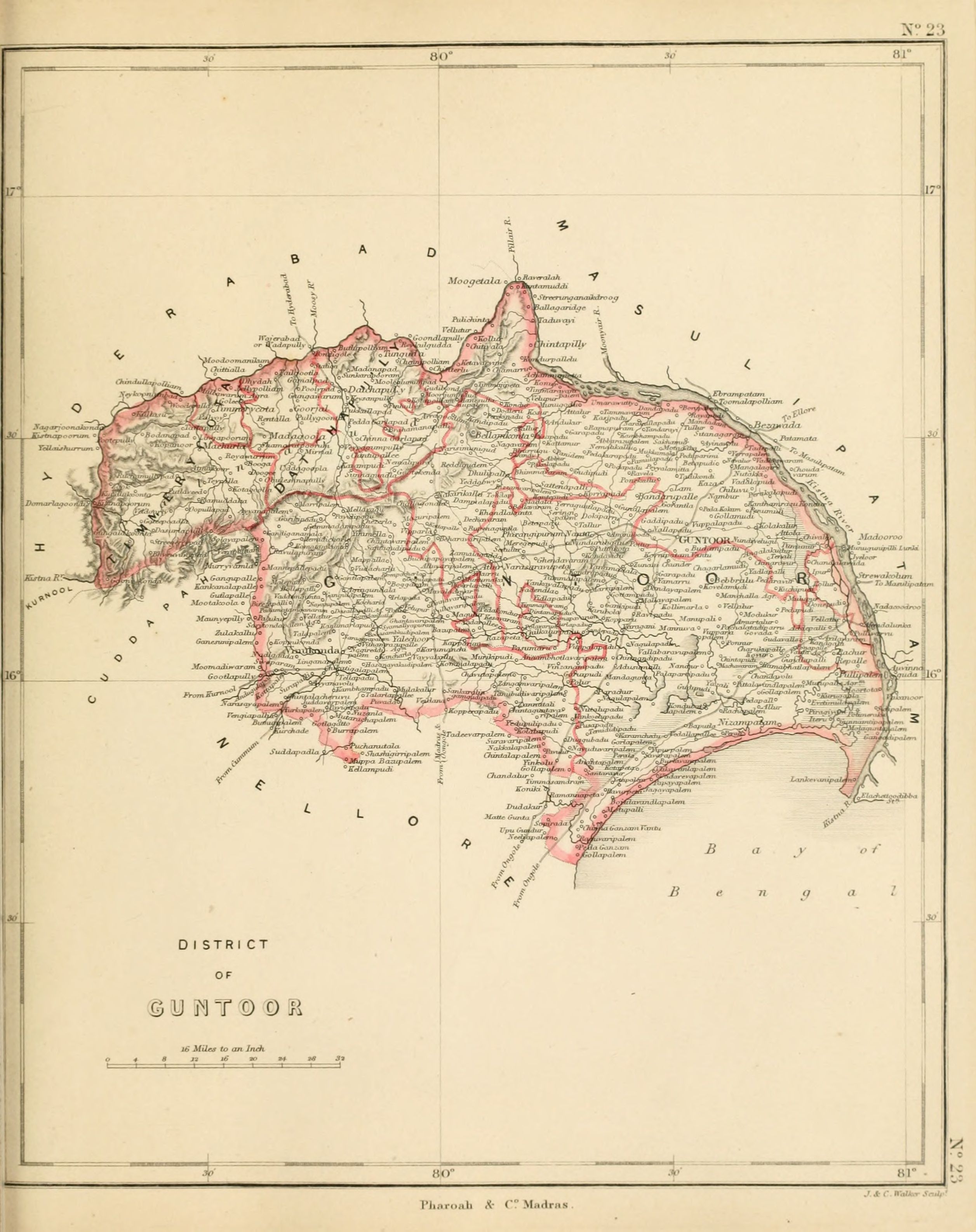
From 1788 Guntur was the headquarters of a district of that name — the old Guntur zillah, not identical with later boundaries. In 1859 that district was abolished. Its territory was divided between Machilipatnam and Rajahmundry, which were renamed Krishna and Godavari, so that two large districts could be organised around the new irrigation systems of the two rivers.
Henry Stokes was Collector and Magistrate from 1842 to 1852. He is the official who invited the Lutheran missionary J. C. F. Heyer to town.
The district was reconstituted on 1 October 1904, headquarters again at Guntur, by taking from old Krishna the taluks of Tenali, Bapatla, Guntur, Sattenapalli, Narasaraopet, Vinukonda and Palnadu, and from Nellore the Ongole taluk. The 1911 Britannica gives the new district’s area as 5,733 square miles and the population on that area in 1901 as 1,490,635. On 1 July 1909 Tenali taluk was split into Tenali and Repalle.
The town: municipality, cotton, water
Keep both truths together. Guntur village is older than the French. The French, in the 1750s, made it a district seat. The British town and municipality came later.
Guntur municipality was constituted in 1866. The first elected body was formed in 1881. The municipality was upgraded to II-Grade in 1891 and to I-Grade in 1917.
In 1901 the town had 30,833 people. It stood east of the Kondavid hills, on the Bellary–Bezwada branch of the Southern Mahratta Railway. It had an important trade in cotton, with presses and ginning factories, and a second-grade college supported by the American Lutheran Mission.
The greater part of the district was already, in that same Britannica article, “a fertile plain irrigated by canals from the Kistna, and producing cotton, rice and other crops.” An anicut across the Krishna had been talked about since 1798. The East India Company’s Court of Directors approved the work on 5 January 1850. The anicut and its canals and flood banks were built 1852–1855, designed by Sir Arthur Cotton and built by Captain Orr, to irrigate about 5.8 lakh acres in the Krishna delta — country that included the Guntur side.
Country tobacco was an older trade. After 1920, Virginia tobacco spread in Guntur; by 1924 large areas were under it. Flue-curing barns multiplied: about 200 in 1930, about 2,500 in 1934, nearly 5,000 by the 1938 season. A 1940 paper said the black-soil tract had long been known as a centre for chillies, groundnut, cotton, and cigar-tobacco, and had recently come into prominence for cigarette tobacco. That is the earliest dated statement used here that Guntur’s black soils were already a recognised chilli centre. It does not give a founding year.
A school, a college, a hospital
The American Lutheran presence is the best-documented social institution of nineteenth-century Guntur. It is a Christian mission story. It is also the story of how many Guntur families first sat in an English classroom or a women’s ward.
John Christian Frederick Heyer, the first missionary sent abroad by American Lutherans, reached Guntur on 31 July 1842, invited by Collector Stokes. That July day is still kept as Gospel Day by the Andhra Evangelical Lutheran Church, which grew from this mission and was organised as a church in 1927. Stokes asked him to manage an Anglo-Vernacular school already in the collector’s gift. Heyer also opened work in Palnadu. His second long stay in the Guntur country was 1847–1857.
The school closed in 1863 during the American Civil War, reopened in 1873 under Dr L. L. Uhl, and in September 1885, with Dr L. B. Wolf as principal, was affiliated to the University of Madras as a second-grade college. Ground was broken for the Watts Memorial on 27 June 1889; the cornerstone was laid by Collector A. T. Arundel on 18 March 1890; the building opened on 17 March 1893, in memory of Arthur G. Watts. The first two women students came in 1914. In March 1926 the college was upgraded to first-grade; in July it was affiliated to the new Andhra University; in January 1928 the name became Andhra Christian College.
Students took part in the Swadeshi and national-education current in 1908, under the leadership of Konda Venkatappayya, and in the Salt / Civil Disobedience moment of 1930.
Anna Sarah Kugler reached Guntur on 29 November 1883, first as a teacher, because the Lutheran board would not yet fund a medical mission. She was appointed medical missionary in December 1885. A dispensary opened in February 1893. The American Evangelical Lutheran Mission Hospital opened on 22 or 23 June 1897 as a 50-bed hospital with surgery, maternity and children’s wards, and a nursing school. Kugler received the Kaisar-i-Hind medal in 1905 and again in 1917. She died in Guntur on 26 July 1930; the hospital was then renamed for her.
Bapatla, 26 May 1913
The demand for a Telugu province was first put as an open conference resolution on this district’s soil.
On 26 May 1913, the First Andhra Conference — the Andhra Mahasabha — met in the Edward VII Coronation Memorial Town Hall, Bapatla. About 800 delegates and several thousand visitors came from the Telugu districts of Madras Presidency. B. N. Sarma led the organising. Konda Venkatappayya of Guntur was secretary. Also present: Bhogaraju Pattabhi Sitaramayya, Mutnuri Krishna Rao, Pingali Venkayya. Vemavarapu Ramadas Pantulu moved a resolution for a separate province. Speakers argued that Telugu districts held about 40 per cent of the people and 58 per cent of the area of Madras Presidency, yet had no effective voice.
Konda Venkatappayya (1866–1948), born in old Guntur, had already founded Krishna Patrika in 1902. He was president of the Guntur District Congress Committee, president of the Andhra Provincial Congress Committee 1918–1923, and a secretary of the All India Congress Committee in 1923.
The conferences continued for decades. This site stops on 15 August 1947. The later formation of Andhra State on 1 October 1953 is the next chapter. It is not told here.
The national movement, to Tenali
Guntur district, after 1904, was not a quiet hinterland. Three local names still stand in the all-India record: Konda Venkatappayya (Desabhakta), Duggirala Gopalakrishnayya (Andhra Ratna), and, from the wider Andhra leadership but repeatedly on this soil, Tanguturi Prakasam.
The political story opens with the new district of 1904 and the Bengal partition of 1905. A public meeting at Ongole on 13 July 1906 attacked the partition. In April 1907 Bipin Chandra Pal spoke at Guntur. The Kotappakonda riot of 1909, on Mahasivaratri in Narasaraopet taluk, was treated by later Congress writers as a political event in the wake of Vande Mataram: police and pilgrims collided at the hill fair. It is a local disturbance with a political afterlife, not a planned satyagraha.
Chirala and Perala, then in Guntur district, were raised toward municipal status in 1919. Village revenue of about Rs. 4,000 a year would have become a municipal demand of about Rs. 40,000. In January 1921 residents refused the new taxes. After the Bezwada Congress of April 1921, Gandhi visited Chirala. In April 1921 about 13,000 of some 15,000 people left the municipal limits for a camp called Ramanagar, with an assembly and a court of arbitration. Duggirala Gopalakrishnayya had organised the volunteer Rama Dandu. The camp lasted about eleven months. When he was jailed, the settlement wound down.
In drought-struck Palnadu, people refused the Pullari forest-produce and grazing tax. Kanneganti Hanumanthu of Minchalapadu led the no-tax. He died in police action; later biographies give 22 February 1922. In January 1922, Pedanandipadu in Bapatla taluk began a no-tax campaign under Parvataneni Veeraiah Chowdary. Gandhi, who had wanted the first such experiment at Bardoli, wrote to Konda Venkatappayya to close it; the taxes were then paid.
The Simon Commission, touring in 1927, met organised boycott at Vijayawada and at Ongole, then in Guntur district. In 1930–31 Konda, as Andhra Congress president, was in charge of Civil Disobedience in the Telugu districts. He was jailed in 1930, 1932, and 1942. Andhra Christian College records a large 1930 movement in Guntur and student participation. Coastal Andhra’s first salt-making that week is usually placed at Machilipatnam on 6 April 1930; a named creek action inside Guntur town is not in the sources used here.
Tenali, 12 August 1942
After Gandhi’s Bombay call of 8 August 1942, district Congressmen Kalluri Chandramouli, Velavolu Seetharamaiah, and Avuthu Subba Reddy planned a bandh at Tenali for 12 August. Crowds attacked a hotel near the station, set fire to an oil tanker at the north cabin, then to the station and a Chennai passenger train. The Collector and Superintendent of Police came from Guntur with reserve police. Firing killed seven:
Majeti Subba Rao, Srigiri Lingam, Bhaskaruni Lakshminarayana, Tammineni Subba Reddy, Gali Ramakotaiah, Prayaga Raghavaiah, Jasti Appaiah.
Hundreds were charged. A penalty of Rs. 2 lakh was laid on the town. Berlin and Tokyo radios broadcast the incident. PIB also notes Quit India demonstrations in Guntur town.
15 August 1947
On that morning Guntur district was still a district of Madras Presidency. The British Indian state ended. The flags changed.
What did not yet change was the map of provinces. A separate Andhra State was still six years away. That 1953 formation is the end of this site’s permission to follow the story. It is mentioned only so a reader knows why the next page is not here.